

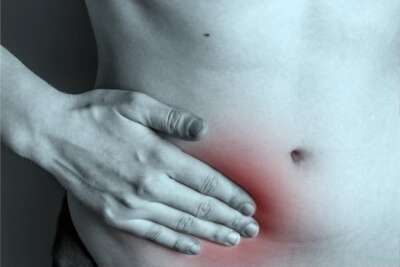
According to the National Center for Health Statistics, nearly 5 million Americans suffer from hernias, a medical condition in which an organ or fatty tissue protrudes through a weak spot in the surrounding muscle or connective tissue. Western medicine treatment for a hernia includes monitoring the condition or surgery, leaving millions of people with extremely limited options. Fortunately East Asian Medicine (EAM) offers alternatives that may take a little longer, but ultimately are less invasive.
There are several types of hernias, but the most common are the inguinal and umbilical hernias. Inguinal hernias occur in the groin area where the intestine or bladder pushes through the abdominal wall. Some inguinal hernias may occur from increased pressure within the abdomen, a pre-existing weak spot, straining during bowel movements, strenuous activity, pregnancy or chronic coughing. In men, large hernias can extend into the scrotum, causing pain and swelling.
Umbilical hernias occur when part of the small intestine passes through the abdominal wall, near the navel. Although umbilical hernias are most common in newborns, adults can also be affected. The cause in adults is increased pressure in the abdomen from obesity, multiple pregnancies or previous abdominal surgeries.
But a hernia in EAM is not just a structural weakness – it’s a sign that your body’s internal holding and lifting function has become compromised. Depending on the underlying pattern, the bulge may feel heavy and dragging, distended and stress-related, cold and cramping, or hot and swollen. Each of these sensations points to a different EAM diagnosis: spleen qi sinking, liver qi stagnation, cold stagnation in the liver or damp heat in the lower jiao.
In EAM, the ability to hold organs and tissues in place is primarily the job of the spleen. The spleen produces qi, the vital energy that animates the body and powers physiological function in EAM, and specifically a type of qi that lifts and supports. When spleen qi becomes weak from overwork, poor diet or chronic illness, this lifting function fails, especially in the lower abdomen. The result is a sinking sensation and eventually a hernia that worsens with fatigue and standing but improves with rest. This is the spleen qi sinking pattern.
But the spleen is not the only player. The liver channel runs through the lower abdomen and groin, and its job is to keep qi flowing smoothly. Emotional stress, frustration or long-held anger can cause liver qi to stagnate, creating pressure and distention along this pathway. This can push tissues outward, leading to a hernia that feels full, distended and is clearly linked to an emotional state.
If the bulge feels cold and the pain is sharp and fixed, worsening in cold weather or after cold drinks, cold stagnation in the liver channel is the key pattern. The person instinctively seeks warmth and the area may feel hard and contracted. The tongue appears pale with a white, moist coating, and the pulse is deep, tight, or slow. These are all signs that cold has congealed in the channel and needs to be warmed and dispersed.
A bulge that feels hot, tender, and possibly red or difficult to reduce points to damp-heat in the lower jiao. There may be sweating, a heavy sensation or urinary discomfort. The tongue is red with a yellow, greasy coating, and the pulse is slippery and rapid. This pattern is more acute and inflammatory, signaling that heat and moisture have accumulated and weakened the tissues.
This is why two people with the same Western diagnosis can have completely different experiences. And it’s also why EAM treatments must be tailored to the individual pattern. A dragging, heavy hernia with fatigue is treated by strengthening spleen qi and raising it upward. A stress-related distending hernia is treated by smoothing liver qi. A cold, cramping hernia is treated by warming the channel. And a hot, damp hernia is treated by clearing heat and drying dampness. By addressing the root cause, EAM aims not just to manage symptoms, but to restore the body’s own ability to hold itself together.
EAM treatments for hernias will always aim to restore the body’s natural ability to hold tissues in place. This means strengthening the spleen and raising qi. when it has sunk, smoothing liver qi when it is stuck, warming the channels when cold has invaded, or clearing damp-heat when it has accumulated. Acupuncture points are generally selected along the spleen, liver and ren (conception vessel) channels to directly support the lower abdomen. Moxibustion (warming therapy) is often added for cold patterns. And because many people have mixed patterns, herbal formulas are customized to address the unique combination of imbalances. The ultimate goal is not just to shrink the bulge, but to correct the internal disharmony that allowed it to develop.
EAM can be safely combined with conventional hernia management, including watchful waiting, truss use, and even after surgery to promote healing. If you suspect that you have a hernia, please get it confirmed with your primary care physician and then you can decide which route you prefer to take.